
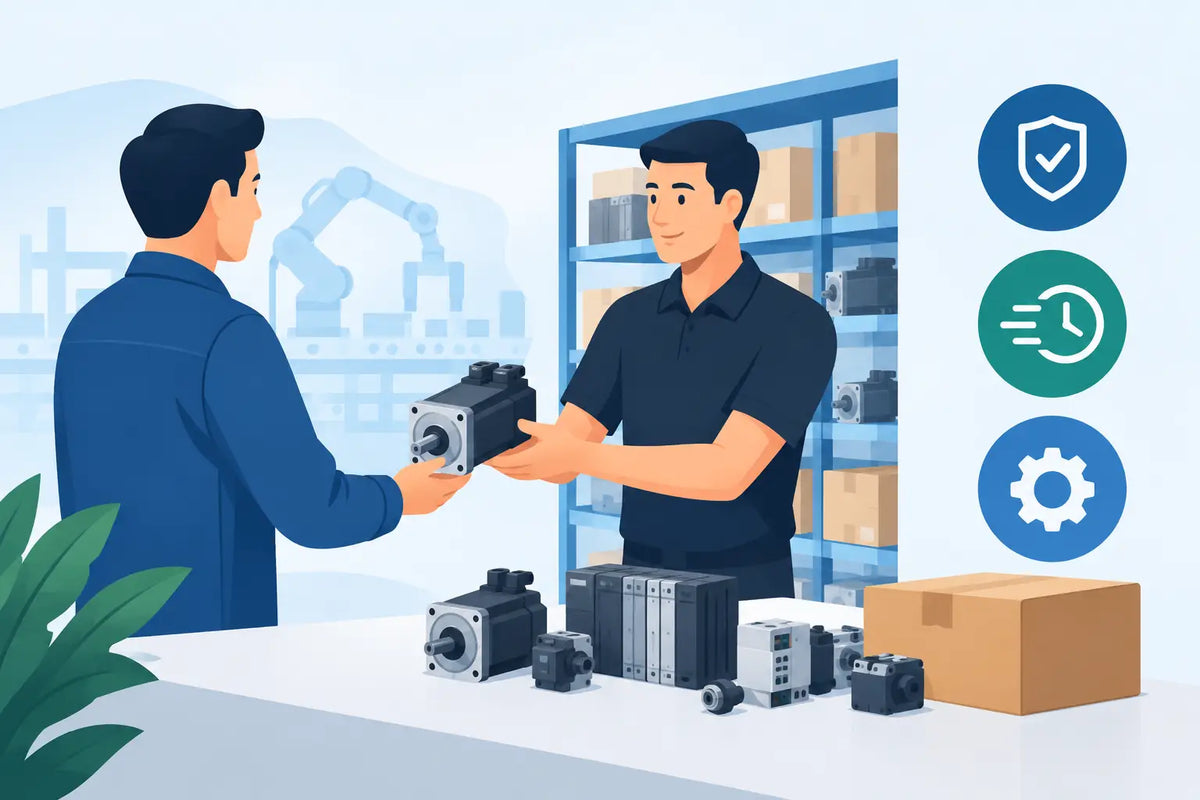
A failed PLC input module at 02:00 is not a purchasing exercise. It is an uptime problem. That is why buy from automation resellers is a practical question for maintenance teams, controls engineers and procurement teams responsible for keeping production equipment running.
When an exact part number is needed, an independent automation reseller can provide another route to stock beyond the original manufacturer’s channel. This matters most when lead times are long, a product has reached end of life, or a replacement is needed before the next shift begins. The value is not in changing a working system unnecessarily. It is in locating the right component, confirming its condition and getting it moving quickly.
Why Buy From Automation Resellers When Uptime Is at Risk
Factory automation is rarely replaced all at once. A site may run current Siemens controls on one line, older Allen-Bradley hardware on another, and Mitsubishi or Omron equipment in packaging cells added years apart. When one component fails, the requirement is usually specific: the same CPU, power supply, communication card, HMI, servo drive or I/O module that is already installed.
OEM channels remain the right choice for many planned purchases, new builds and applications requiring current-generation technical support. But they cannot always solve an immediate legacy-parts problem. A manufacturer may have discontinued the item, moved it to a successor range, or quoted a lead time that does not match the cost of a stopped line.
Automation resellers operate in the secondary market, sourcing surplus, unused inventory and refurbished equipment across multiple brands. That wider supply base can make a difficult part number available when conventional routes cannot. For a plant, that can mean repairing proven equipment rather than redesigning a panel, rewriting code or accepting extended downtime.
Exact part-number sourcing reduces avoidable risk
A close-looking module is not necessarily a compatible module. Firmware revisions, electrical ratings, network variants, terminal arrangements and rack compatibility can all matter. Buyers should start with the complete manufacturer part number from the nameplate, including suffixes and revision details where relevant.
A reseller’s part-number-led catalogue supports this workflow. Instead of searching broadly for a "similar PLC card", a buyer can check availability against the exact identifier required. This is particularly useful for parts such as Allen-Bradley ControlLogix modules, Siemens SIMATIC components, Schneider Electric drives, Omron PLC hardware and Mitsubishi automation equipment, where small differences can affect fit or function.
The buyer still owns final compatibility verification. Compare the listing with the failed unit, drawings, machine documentation and approved bill of materials. For critical applications, involve the controls engineer before placing the order. Fast supply only helps when the supplied part is correct.
Access to Legacy and Discontinued Automation Stock
End-of-life status does not mean a machine has stopped being commercially valuable. Many production assets continue to perform reliably for years after their original automation platform has been superseded. Replacing an entire controls system may be justified eventually, but it is rarely a sensible response to every isolated module failure.
An independent reseller can hold inventory that no longer appears in a manufacturer’s current catalogue. This stock may come from decommissioned lines, unused project spares, cancelled installations or surplus stores. It gives maintenance teams an option between accepting a long-term modernisation project and making a targeted repair today.
That does not make legacy sourcing risk-free. Older parts may be scarce, and availability can change quickly. Where a site relies on an obsolete platform, each urgent purchase should prompt a wider discussion about critical spares, lifecycle planning and migration timing. Buying the replacement gets the line back into service; securing a sensible spare position may prevent the same crisis recurring later.
One supplier can cover more than one OEM ecosystem
Single-brand procurement can be efficient when every requirement belongs to one current platform. It is less efficient when a maintenance shutdown identifies needs across several control systems. Sourcing a Siemens power supply, Allen-Bradley I/O module, Omron sensor controller and Schneider contactor through separate channels creates more quotations, more deliveries and more administration.
Multi-brand automation resellers can reduce that fragmentation. A buyer can submit several exact part numbers to one supplier and assess what is available from one source. It will not always be possible to fulfil every line from a single location, and price should still be checked against condition and urgency. However, consolidating difficult-to-find requirements can save valuable procurement time during a breakdown or planned outage.
New and Refurbished Condition Options
Condition is a purchasing decision, not a footnote. A clear listing should state whether an item is new and sealed or refurbished. These options serve different requirements.
New and sealed stock is often preferred where site standards require unused components, where equipment is being commissioned, or where an approved spare must match a specified condition. It may also be the sensible choice for parts that are relatively affordable and readily available.
Refurbished equipment can be a cost-effective option for repair work, legacy platforms and non-critical spares, especially where new stock is unavailable. A properly represented refurbished item should be described as such, rather than presented as new. Buyers should ask what inspection or testing has been carried out, what warranty or return terms apply, and whether the item includes accessories such as plugs, terminals, keys, memory cards or covers.
The right choice depends on the application. A module supporting a safety-related function, regulated process or high-consequence operation needs a more stringent review than a standard replacement on a non-critical auxiliary system. Refurbished does not automatically mean unsuitable, and new does not remove the need for compatibility checks. The important point is to buy with the condition, use case and risk level understood.
Faster Procurement Without Losing Control
Speed has value, but rushed procurement can create a second failure. The most useful reseller relationship combines quick response with enough information for the buyer to make a controlled decision. For urgent requirements, provide the full part number, quantity, required condition, delivery location and deadline in the first enquiry. If a serial range, hardware revision or firmware level matters, include that too.
Before committing, confirm stock status rather than assuming a web listing represents allocated inventory. Ask whether the item is physically in stock, when it can dispatch, and what delivery service is available. For a line-down event, clarify cut-off times and whether a faster service is realistic. A low unit price is not the best outcome if the part arrives after the production loss has already exceeded the saving.
A practical check before ordering includes these points:
- Match the full manufacturer part number, suffix and relevant revision.
- Confirm whether the item is new and sealed or refurbished.
- Check physical stock, dispatch timing and delivery method.
- Review returns, warranty and testing information.
- Retain photographs, order records and compatibility approval for traceability.
Surplus Stock Can Fund the Next Critical Spare
Many sites hold automation stock that no longer supports active equipment. It may be left from a line upgrade, held after a cancelled project or recovered during a panel replacement. In a storeroom, those parts can become invisible capital: too valuable to discard, but not organised well enough to be used.
Selling surplus to a specialist automation buyer can release space and turn dormant inventory into budget for current spares. It also returns usable components to the market, where another plant may need the exact item to keep an older line running. This is particularly relevant for OEM parts that have been discontinued but remain installed across industry.
Start with an inventory by part number, quantity and condition. Keep original packaging where possible and separate known-working stock from untested items. Accurate information helps the buyer assess the material quickly and avoids delays caused by uncertain descriptions.
Independent Supply Requires Clear Expectations
Buying from a reseller is different from buying directly from an OEM or an authorised distributor. An independent supplier should state this clearly. It should not imply manufacturer authorisation, official affiliation or OEM warranty where none exists.
That transparency helps buyers make the correct decision. A reseller may offer availability, cross-brand sourcing and access to legacy stock that an authorised route cannot provide. In return, the buyer should review the supplier’s product condition, commercial terms and return process carefully. For standard replacement parts, this can be a highly effective route. For design changes, safety systems, warranty-sensitive installations or applications requiring manufacturer engineering support, the authorised channel may be the better fit.
Automation Planet UK provides independent sourcing for industrial automation part numbers across major OEM ecosystems, with new and sealed and refurbished options identified at the point of purchase. The focus is straightforward: help buyers locate the parts needed to repair, maintain and support installed equipment.
When a critical module fails, start with the full part number and the facts that affect compatibility. Confirm the condition you can accept, check dispatch timing, and keep a record of the decision. That disciplined approach turns a difficult spare-parts search into a controlled recovery action - and gives your team a better chance of having the next critical spare ready before it is needed.