
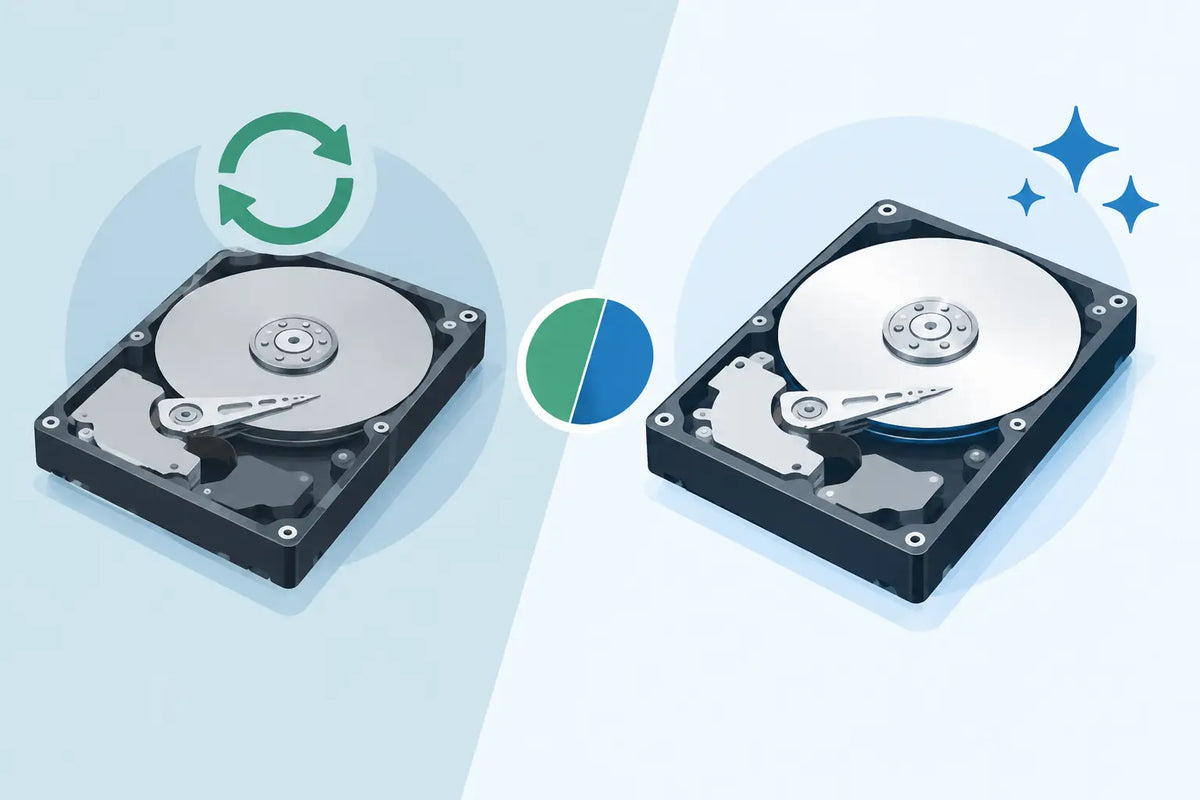
A failed drive is rarely a planned purchasing event. When a conveyor, pump, fan or production cell stops, the priority is locating the exact compatible replacement before lost output turns into a larger maintenance problem. That is where refurbished drives versus new inventory becomes a practical sourcing decision, not simply a budget comparison.
For an industrial buyer, the right answer depends on the part number, the age of the installation, the required delivery date and the consequences of another failure. New and sealed stock can provide clear condition certainty. Refurbished stock can keep legacy equipment running when authorised channels have no stock, extended lead times or an end-of-life notice. Both have a place in a sensible spares strategy.
Refurbished drives versus new inventory: the operational difference
New inventory is generally unused equipment supplied in its original manufacturer packaging or equivalent sealed condition. For current production ranges, it is often the most straightforward option: match the complete part number, verify voltage and power rating, confirm any required option cards or fieldbus interfaces, and install according to the manufacturer documentation.
Refurbished inventory is equipment that has previously been in service and has been prepared for resale. Its value is usually strongest where a replacement must match an installed system that is no longer easy to support through normal distribution. This commonly includes discontinued variable frequency drives, servo drives, legacy PLC racks, operator panels and communication modules from Siemens, Allen-Bradley, Mitsubishi, Schneider and Omron ecosystems.
The word "refurbished" should never be treated as a universal technical standard. The actual work undertaken can vary by supplier and by product type. Buyers should establish what has been inspected, tested, repaired or replaced, whether the unit has been function-tested under load where appropriate, and what warranty terms apply. Condition descriptions are useful only when they are specific.
When new and sealed stock is the better purchase
New inventory is often the lower-risk route for a critical current-model drive, particularly where the equipment is being fitted to a new machine, used in a safety-sensitive process or installed under a customer specification requiring unused components. It may also simplify commissioning when firmware, documentation and accessories need to align with a current approved design.
It is a strong choice when the exact drive is readily available and the cost of downtime outweighs the price difference. A plant with one production line and no installed spare may reasonably pay more for immediate, sealed replacement stock if it removes questions about previous operating history.
New stock also makes sense when a buyer needs a matched configuration rather than a basic drive body. Many drives rely on precise combinations of control units, power modules, feedback cards, keypad panels, braking hardware and communications options. A new assembly can be easier to specify when the plant is standardising equipment across several sites.
That said, "new" does not automatically mean locally available. A current part number may still be subject to factory allocation, long lead times or regional stock restrictions. It is worth checking physical availability rather than relying on a catalogue status alone.
Where refurbished drives provide a clear advantage
Refurbished drives are particularly useful when a machine is built around an older platform and replacing the drive with a modern alternative would require engineering changes. A newer model may need different parameters, mounting arrangements, motor cabling, feedback hardware, PLC logic or network integration. On some machines, that upgrade work is sensible. During an unplanned outage, it may be neither quick nor economical.
An exact refurbished replacement can reduce that scope. If the full manufacturer part number, revision and installed options match, the maintenance team may be able to restore the machine with minimal changes. This is especially relevant for plants that retain mature equipment because it remains productive, validated or difficult to replace.
Cost is another factor, but it should be measured correctly. The purchase price of a refurbished drive may be lower than new stock, yet the real comparison is total recovery cost: unit price, freight, installation time, parameter recovery, commissioning risk and lost production. A refurbished unit that arrives quickly and fits the existing application can be the more economical choice even if it is not the cheapest listing.
Secondary-market stock also gives procurement teams another route when a manufacturer has discontinued a range. Independent multi-brand suppliers can source surplus and refurbished inventory from closed projects, plant upgrades and excess stores. This does not replace OEM support, but it can provide access to equipment that would otherwise be unavailable.
Check compatibility beyond the visible part number
Drives are not interchangeable simply because their power rating looks similar. Before purchasing, verify the complete manufacturer reference, including suffixes, revisions and option codes. Photograph the existing nameplate where possible. A single character can indicate a different supply voltage, enclosure type, input configuration, communication protocol or control method.
Confirm the electrical and application requirements as well. Review input voltage and phase, output current, motor rating, overload duty, braking requirements, encoder or resolver feedback, environmental rating and installed fieldbus network. For motion applications, firmware and feedback compatibility can be as important as the drive's physical rating.
Parameter retention deserves attention. A replacement drive may require settings to be loaded from a keypad, engineering laptop, removable memory card or PLC backup. If the failed unit is still accessible, secure its parameter set before removal. If it is not, identify whether a documented machine backup exists. Buying the correct drive is only one part of getting a process moving again.
Questions to ask before approving refurbished stock
Request the condition classification and ask what testing has been carried out. Confirm whether the listing includes the keypad, terminal covers, control module, option cards and any mounting hardware shown or required. Establish the warranty period, return procedure and whether the item is available for dispatch rather than merely being sourced against an enquiry.
For a critical spare, ask for clear photographs of the actual unit and its rating label. This helps verify the physical condition and avoids an avoidable mismatch between a generic product image and the item being supplied. If the drive is a legacy model, provide the supplier with the complete part number and details of the application rather than a broad family reference.
Build the decision around downtime exposure
A sensible procurement approach divides drives into categories. For current, high-volume models supporting standard machinery, new and sealed stock may be the preferred baseline. For discontinued or difficult-to-source models, refurbished units and tested surplus can form the core of the spares plan. For high-consequence assets, holding one verified on-site spare can be less costly than sourcing any replacement during a breakdown.
The decision also changes according to the role of the drive. A non-critical ventilation drive may allow time for a modern replacement and planned retrofit. A drive controlling a bottling line, furnace extraction system or machine tool spindle may not. In the second case, immediate compatibility usually carries more value than a theoretical long-term standardisation benefit.
It is also worth separating emergency replacement from planned modernisation. A retrofit project can be engineered properly: assess the motor, control system, safety circuit, cabling, harmonics, panel cooling and operator training. An emergency repair should focus on restoring safe operation with the lowest practical disruption. Trying to combine both objectives in the middle of downtime often creates delay.
Procurement controls that prevent avoidable delays
Keep an asset register that records complete drive part numbers, serial numbers, installed options, firmware where relevant, machine location and parameter-backup location. Include a note of approved alternatives only after they have been technically reviewed. This turns a breakdown request from "we need a 15 kW inverter" into a sourceable, part-number-specific requirement.
For older equipment, review stock before it fails. If a drive family has been discontinued, identify whether spare units are available in new surplus or refurbished condition and set a realistic reorder point. A plant with several identical legacy drives may benefit from holding a spare, especially when replacement would otherwise involve a redesign.
When surplus equipment is created by a line upgrade, do not treat it all as scrap. Serviceable drives, PLC modules and related automation hardware may retain practical value for other plants or secondary-market buyers. Selling excess stock can recover budget while placing hard-to-find components back into the supply chain. Automation Planet UK LTD supports this type of sourcing and surplus redeployment across multiple industrial automation brands.
Buy the condition that solves the actual problem
There is no universal winner between refurbished and new inventory. New stock offers unused condition and can be the preferred choice for current, critical specifications. Refurbished stock offers an effective route to legacy compatibility, faster availability and lower recovery cost when an exact replacement matters most.
The useful question is not which condition is better in principle. It is whether the specific unit is correctly identified, genuinely available, suitable for the application and supported by clear condition and warranty information. Start with the full part number, confirm the installed configuration, and make the purchase decision around the cost of keeping the machine stopped.