
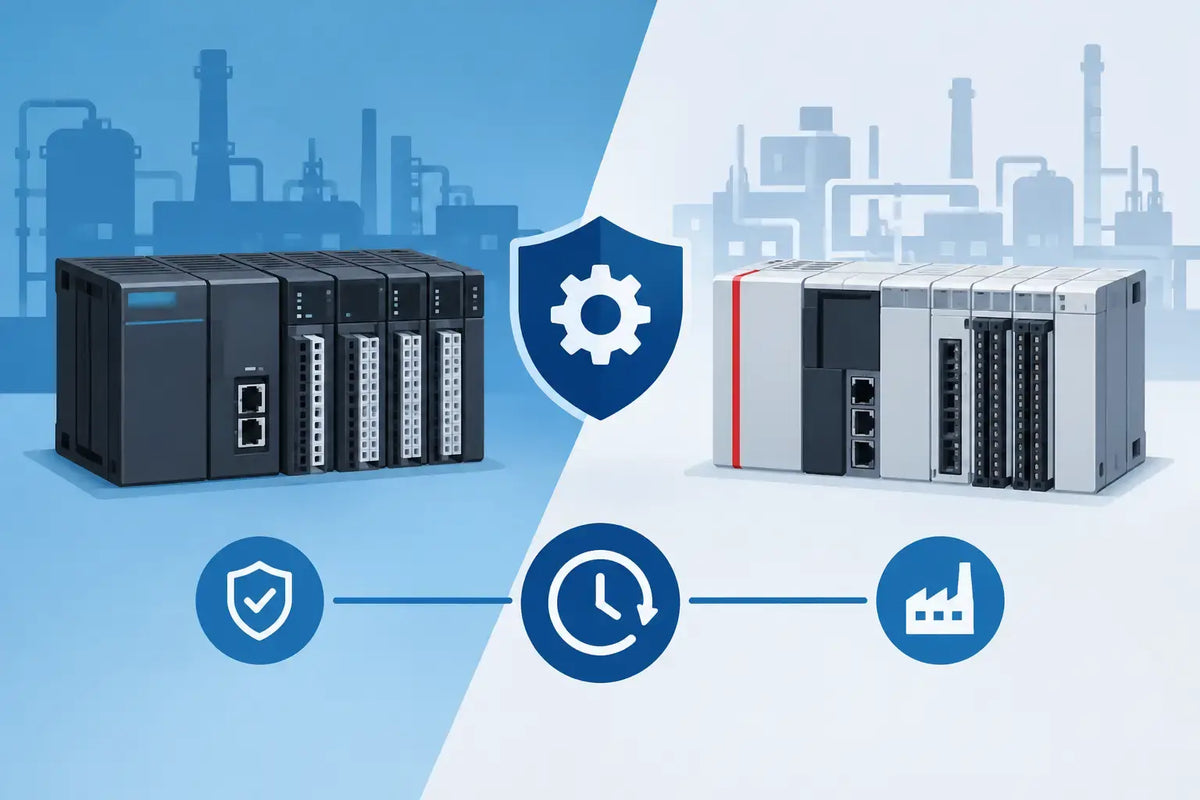
A failed PLC rarely creates a brand-selection exercise. It creates a production problem: identify the exact CPU, confirm the I/O rack and communications cards, and get a compatible replacement on site without introducing fresh commissioning risk. That is the practical context for comparing Omron vs Mitsubishi PLCs. Both are established automation platforms with strong installed bases, but their best fit depends on the machine, the software already held, the field network, and the availability of the correct part number.
For a running plant, the right answer is usually not the controller with the longest feature list. It is the one that restores operation with the least disruption and leaves the maintenance team able to support the asset.
Omron vs Mitsubishi PLCs: the operational difference
Omron is commonly seen on machinery where integrated control, safety, vision and motion are closely tied together. Its newer NJ and NX families sit within the Sysmac platform, where PLC logic, EtherCAT motion, safety and other machine functions can be engineered in a more unified environment. This can suit packaging, assembly, inspection and handling equipment where synchronised axes and machine-level performance matter.
Mitsubishi Electric has a particularly broad footprint in compact and modular machine control. FX and iQ-F controllers are frequent choices for smaller machines and straightforward control tasks, while the iQ-R platform supports larger, more demanding applications. Mitsubishi is also widely encountered in OEM machinery, so the deciding factor may simply be the installed system and the engineer's familiarity with GX Works software.
Neither platform is a universal upgrade path for the other. An Omron CPU cannot be treated as a drop-in substitute for a Mitsubishi CPU, even where the I/O count and headline specification look similar. The program, terminal arrangement, network architecture, expansion bus, power supply and safety design all require review.
Start with the installed base, not the catalogue
For maintenance replacement, matching the existing series is normally the lowest-risk route. A Mitsubishi FX3U, for example, may need an exact FX-series replacement or a planned migration using the correct conversion approach. Replacing it with an iQ-F may be sensible, but it is a project rather than a like-for-like spare change. The same applies to Omron CJ, CS, NJ and NX hardware. Families differ in programming tools, accessories, backplanes and supported communications.
A controls engineer should first establish whether the part has failed in isolation. A CPU fault can also be caused by a degraded power supply, a damaged output module, an intermittent rack connection, an incorrect battery state or a communications issue. Replacing only the processor before verifying the fault may waste valuable downtime.
Exact suffixes matter. CPU variants can differ by memory capacity, port configuration, integrated Ethernet, motion capability or regional specification. I/O modules may look alike while using different wiring bases or electrical characteristics. For procurement, the manufacturer part number from the label should be the starting point, followed by photographs and a check against the installed hardware.
Programming and commissioning implications
The software environment is one of the clearest practical differences between the platforms. Omron's modern NJ and NX systems are generally programmed through Sysmac Studio. This is designed around IEC 61131-3 languages and integrated configuration of connected machine devices. It is useful where structured programming, motion configuration and EtherCAT topology are central to the application.
Mitsubishi systems are commonly supported through GX Works2 or GX Works3, depending on the controller generation. Many maintenance teams know Mitsubishi ladder conventions well, particularly on FX, Q and L installations. A familiar programming environment reduces diagnostic time, but that benefit depends on having the correct project files, software version, licences and communications leads available.
Do not assume a program can simply be uploaded from a replacement PLC or converted between brands. Password protection, missing comments, absent symbol tables and undocumented field devices can turn an apparently simple job into a lengthy reverse-engineering exercise. Before changing hardware, secure a verified backup of the live application where possible. Record firmware revisions, CPU mode, network settings and any removable memory card details.
For a new machine, the choice is more open. Omron may be preferable where the design is centred on EtherCAT-connected servo motion and an integrated Sysmac architecture. Mitsubishi may be preferable where the machine builder already standardises on FX or iQ hardware, where existing libraries can be reused, or where the site holds trained support staff and compatible spares. Standardisation has a real cost benefit over the life of the equipment.
I/O, networks and motion are where compatibility is decided
A PLC is not only a CPU. The surrounding hardware determines whether a repair is quick or whether a re-engineering task has begun. Check the number and type of digital I/O, analogue signals, high-speed counters, temperature inputs, load type and isolation requirements. Output type is especially important: relay, transistor and triac outputs are not interchangeable choices when connected equipment and switching duty are considered.
Both brands offer remote I/O and industrial Ethernet options, but the network in use must be identified precisely. Omron installations may use EtherCAT for deterministic machine networks and EtherNet/IP in wider automation architectures. Mitsubishi installations can involve CC-Link families, CC-Link IE Field, CC-Link IE TSN, Ethernet or serial communications, depending on platform and machine age.
Network compatibility should be checked at device level, not assumed from the port shape. A machine may depend on a specific motion network, remote I/O coupler, HMI driver, inverter interface or safety controller. Replacing a CPU with a newer generation can require firmware changes and reconfiguration across the line.
Motion control deserves the same caution. Modern Omron NJ and NX systems can make coordinated servo control a natural part of the control design. Mitsubishi's motion options are likewise capable, particularly within iQ-R architectures, but the servo amplifiers, network topology and engineering tools remain ecosystem-specific. If the application controls cams, registration, electronic gearing or safety-rated motion, plan for functional testing after any controller change.
Legacy hardware and spare strategy
The strongest argument for either brand may be the equipment already installed. A plant with twenty Mitsubishi-controlled machines benefits from holding selected Mitsubishi spares, known-good cables and software access. A site built around Omron can reduce risk by holding critical Omron CPUs, power supplies and network modules. Cross-brand standardisation sounds attractive, but replacing healthy controllers solely to consolidate brands may create unnecessary validation work.
Legacy availability changes the buying decision. When an OEM channel no longer stocks a discontinued reference, a new and sealed or refurbished unit can keep a proven machine productive while a longer-term migration is planned. Condition should be stated clearly, and refurbished equipment should be sourced with enough traceability to support the repair decision. For critical assets, it is sensible to buy a tested spare before the installed unit fails rather than during a stoppage.
A useful procurement record includes more than the CPU part number. Keep the power supply, rack or base, I/O modules, communication cards, programming cable, memory media, firmware revision and application backup together. This prevents the common situation where a replacement CPU is available but cannot be commissioned because one small interface component is missing.
When reviewing stock from an independent supplier such as Automation Planet UK, provide the full part number and advise whether an exact replacement, an alternative reference or a complete rack is required. That allows availability and condition to be checked against the actual maintenance need rather than a broad product-family description.
What to verify before placing an order
For a planned replacement or emergency spare purchase, confirm these points before committing:
- The complete manufacturer part number, including suffixes and revision identifiers.
- The PLC family, rack or base type, power-supply requirement and installed expansion modules.
- The application software, firmware level, backup status and required programming connection.
- The field network, HMI, drive, servo, remote I/O and safety devices connected to the controller.
- Whether the requirement is an exact spare, a tested refurbished unit, or a migration to a current platform.
The better choice between Omron and Mitsubishi is therefore often already visible in the control panel. Buy the platform that matches the machine, the files, the network and the support capability available on site. Where that platform is becoming difficult to source, secure the correct spare now and schedule the migration on your terms, not during the next unplanned stop.