
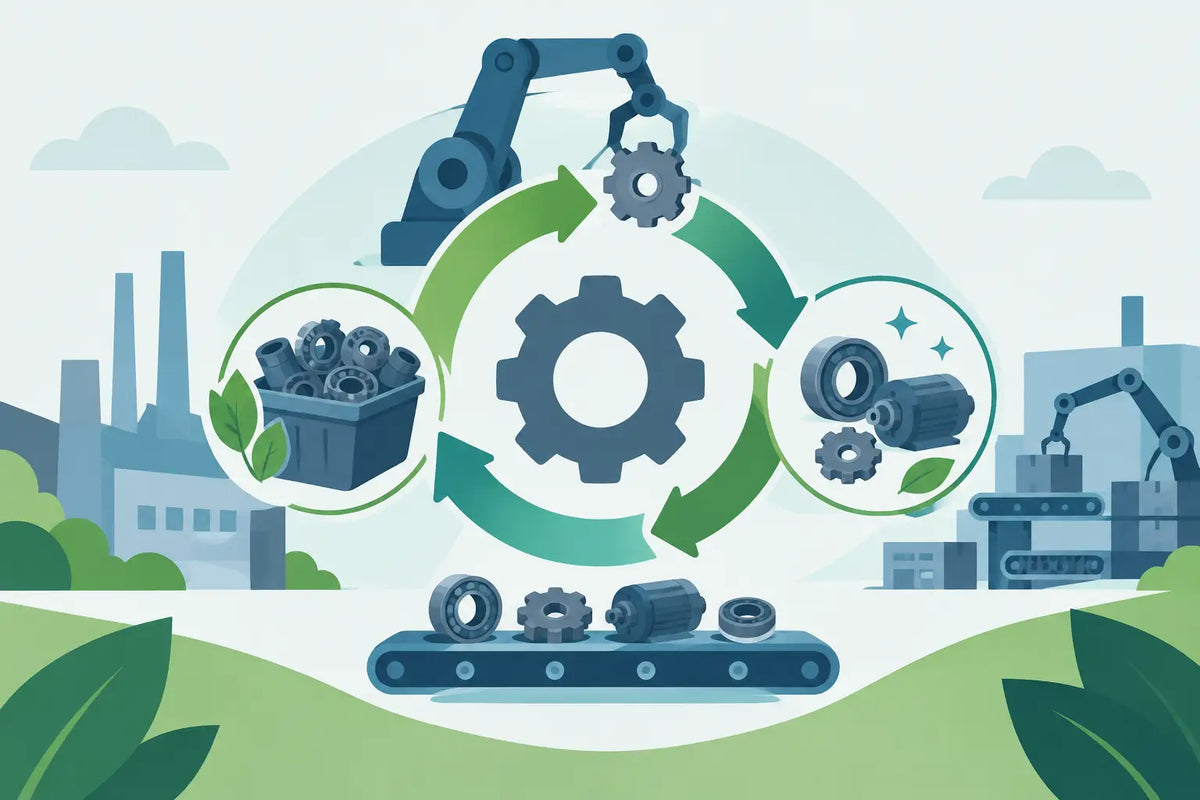
A failed PLC output module at 2am does not become less urgent because its product range is obsolete. For maintenance teams, the automation circular economy is not an abstract sustainability target. It is a practical way to keep production equipment running by returning usable industrial components to service instead of allowing them to sit in stores, enter waste streams, or disappear with a decommissioned line.
The principle is straightforward: retain value in hardware for as long as its condition, specification and application allow. In industrial automation, that can mean purchasing a refurbished HMI to support a legacy machine, holding a tested spare drive, or selling surplus Siemens, Allen-Bradley, Mitsubishi, Schneider or Omron stock so another plant can use it.
Why automation hardware suits a circular model
Industrial control systems are rarely replaced all at once. A production line may receive mechanical upgrades while its PLC rack, remote I/O, power supplies and operator panels remain in service for years. Even where a newer platform exists, migration can require engineering time, validation, programming changes, downtime and budget that a site does not have available.
Many components removed during an upgrade are still serviceable. Others are new and sealed but surplus to requirements after a project specification changes. A circular approach creates a route for those parts back into the supply chain, where they can support a repair or planned spare-parts strategy elsewhere.
This matters most when availability is tight. An OEM may have discontinued a part number, quoted a long lead time on a replacement platform, or require a broader system upgrade. None of those options necessarily solve an immediate production stoppage. Secondary-market stock can provide a practical bridge, provided the buyer verifies compatibility and condition before purchase.
The benefit is not simply lower purchase cost. It is reduced exposure to downtime, better use of capital already embedded in equipment, and a more realistic way to support installed legacy systems. A refurbished component may not be the right choice for every critical application, but it can be a sensible option when correctly assessed.
Automation circular economy decisions start with the part number
Circular sourcing works only when identification is accurate. “A Siemens PLC card” or “an Allen-Bradley drive” is not enough information for a buyer to make a safe replacement decision. The exact manufacturer part number, revision, firmware requirements, voltage rating, communication interface and physical configuration can all affect whether a component will work in the existing system.
Start with the label on the failed or required unit. Record the full catalogue number, including suffixes, series or revision markings, and any date codes that may matter. Photograph the rating plate and connectors if the item is being handed over from a site team to procurement. This avoids a common and costly problem: buying a unit that looks identical but has different I/O, network or power characteristics.
For PLC hardware, check the rack or chassis compatibility, processor family, memory card requirements and communication modules already installed. For variable-speed drives, confirm motor ratings, supply voltage, enclosure type, feedback arrangement and parameter backup. With HMIs, display dimensions and mounting may match while the connection type, firmware support or application transfer method does not.
A circular purchase should be treated with the same technical discipline as a new part purchase. The fact that an item is discontinued, refurbished or sourced from surplus does not remove the need for engineering sign-off.
New and sealed versus refurbished stock
Condition should be clear before an order is placed. New and sealed surplus stock can be attractive where the exact part is required and the packaging, labels and storage history give the buyer confidence. It may be particularly useful for strategic spares that will be held on site.
Refurbished stock serves a different but equally valuable role. It can provide access to models that are no longer available new, often at a lower cost than replacement through a full platform migration. However, “refurbished” is not a universal condition standard. Buyers should establish what has been inspected, repaired or functionally tested, whether cosmetic marks are present, and what warranty or return terms apply.
It depends on the duty of the component. A spare for an auxiliary conveyor may justify a different risk and budget decision from a safety-related controller, a high-speed motion module or a drive controlling a process-critical pump. The responsible approach is to match the condition option to the operational consequence of failure.
Turn surplus stock into available supply
Most plants have value tied up in cupboards, maintenance stores and project containers. Common examples include unused I/O cards from a cancelled upgrade, spare contactors from an old panel build, drives held after a machine retirement, and sealed PLC modules left over from a commissioning package.
If these items have no defined future use on site, they are not protecting uptime. They are tying up space and capital while becoming harder to identify over time. Selling usable surplus can put that inventory back into circulation and create budget for the spares that the plant actually needs.
Before releasing stock, carry out a basic inventory exercise. Separate unopened parts from used equipment, retain any original packaging, and record complete part numbers and quantities. Include known condition details honestly. A clear inventory list allows a specialist buyer to assess demand quickly and reduces back-and-forth during valuation.
Do not assume every old item should be sold. Keep documented critical spares where an installed asset still depends on them, especially if the line has no practical replacement plan. The objective is not to empty the stores room. It is to distinguish between a justified insurance spare and inventory that has become stranded.
Build circular sourcing into maintenance planning
Emergency purchasing will always exist, but the best results come when circular sourcing is planned before a failure. Maintenance and procurement teams can identify high-risk legacy parts, confirm which stock is fitted, and establish acceptable alternatives or repair routes while the equipment is still operating.
A useful programme usually includes four controls:
- Maintain an asset register with exact part numbers, quantities fitted and known revisions.
- Set minimum and maximum levels for genuinely critical spares rather than buying duplicates without a plan.
- Review dormant and surplus stock after upgrades, shutdowns and project completion.
- Record approved secondary-source options, including acceptable condition and required technical checks.
There are limits. Circular supply is not a substitute for a lifecycle strategy. If a control platform is unsupported, increasingly unreliable or impossible to secure, a phased migration may be the lower-risk long-term decision. Secondary-market availability can buy time, but it should not be used to defer essential engineering work indefinitely.
Protect uptime without creating new risk
The circular economy case becomes weak if poor traceability introduces counterfeit, damaged or incompatible hardware into a plant. Buyers should use suppliers that describe product condition plainly, identify items by part number and provide a clear route for questions before purchase. Ask for photographs or label details when revision matters, and keep purchase records against the asset history.
On receipt, inspect packaging and the unit before installation. Compare the delivered label to the purchase order and to the removed component. For critical equipment, use controlled installation, configuration backup and functional testing procedures. A compatible spare is only useful if its parameters, firmware and field wiring are also understood.
There is also a legal distinction worth keeping clear. An independent supplier may stock equipment from major OEM ecosystems without being authorised, affiliated with or endorsed by those manufacturers. That does not prevent a legitimate resale transaction, but it means buyers should base their decision on the stated condition, documentation, support terms and their own technical verification rather than assuming OEM channel status.
For plants managing mixed automation estates, Automation Planet UK can support this practical model through part-number-led sourcing across new and sealed and refurbished industrial automation stock, as well as surplus buyback. The value is speed and availability, but the purchase still starts with an accurate requirement.
A spare module has no value when it is unlabelled in a forgotten cabinet. Identify it, assess whether it is genuinely needed, and either assign it to a critical asset or return it to the supply chain where it can keep another machine working.