
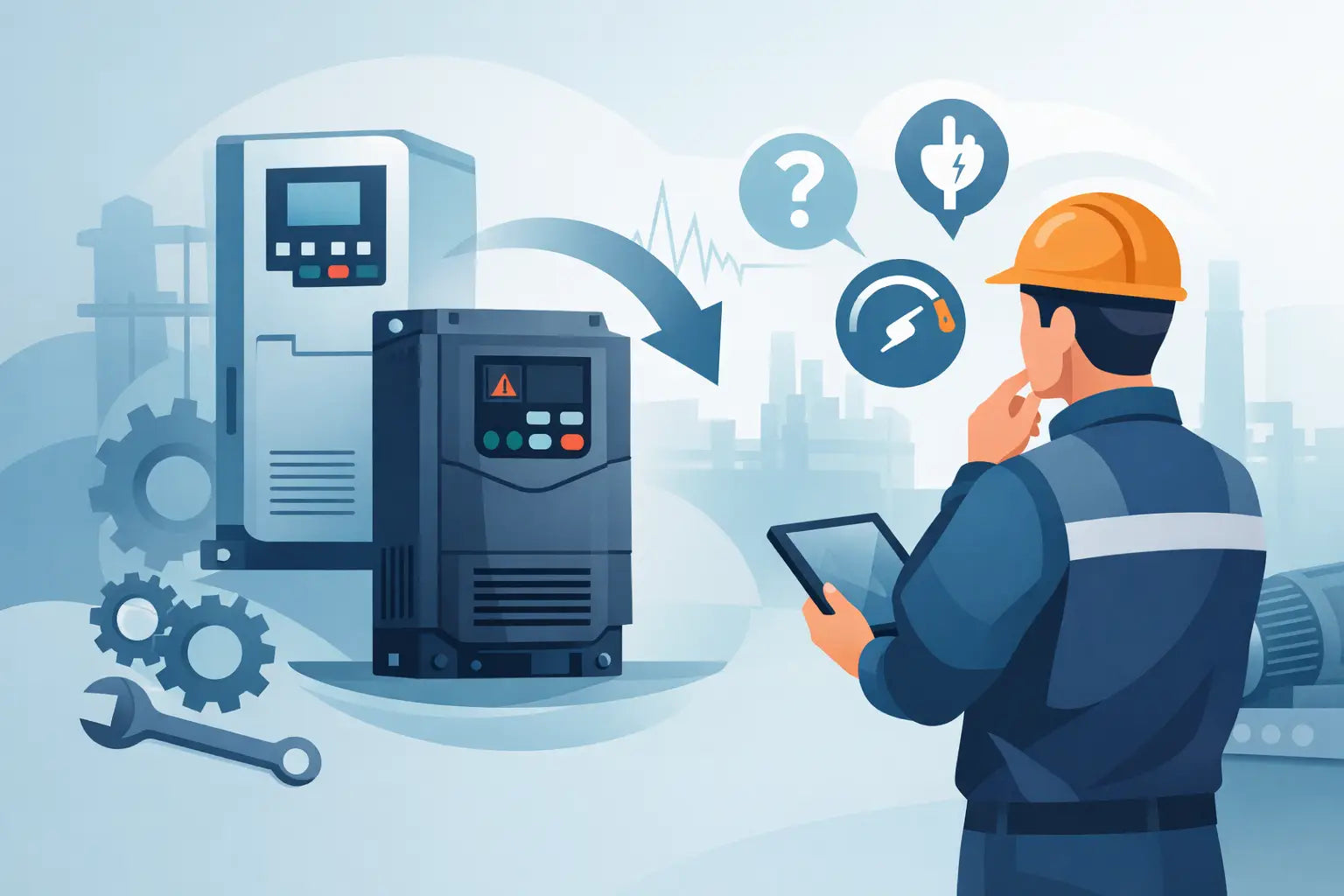
A failed drive inverter rarely gives you a convenient window to think it through. One minute a line is running, the next you are looking at a fault code, a stopped motor and production asking for an answer now.
That is why industrial drive inverter replacement is usually less about theory and more about speed, fit and risk. The right decision depends on what failed, how critical the asset is, whether the exact part number is still available, and how much downtime your site can absorb.
Industrial drive inverter replacement starts with the part number
Before anyone talks about repair versus replacement, confirm the exact unit fitted today. On most sites, trouble starts when a drive is identified by series only instead of full catalogue number, firmware variant or input and output rating.
A Siemens, Allen-Bradley, Mitsubishi, Schneider or Omron drive may look close enough across the same family, but small differences matter. Voltage class, enclosure type, braking option, communications card support and keypad compatibility can all turn a "near match" into lost hours on the shop floor.
If the existing label is readable, work from the full manufacturer part number. If it is damaged, pull the number from your panel drawings, BOM, maintenance records or previous purchase history. For legacy machines, also check whether the drive was supplied with a specific parameter set or application card. Replacing hardware is one thing. Getting the machine back to known operating behaviour is another.
Repair or industrial drive inverter replacement?
There is no universal answer here. Sometimes repair is the sensible call. Sometimes it is wasted time.
If the drive is a current model, the fault is isolated, and you have a backup unit on the shelf, repair may be acceptable. That is especially true for non-critical assets where lead time pressure is low. But when the drive has already failed in service, the line is down, and there is no spare available, replacement is often the cleaner decision.
Replacement also becomes more attractive when the drive is end-of-life, intermittently failing, or showing wider age-related issues such as capacitor wear, cooling fan failure or communication instability. In those cases, a repair can solve one fault while leaving another one waiting behind it.
The trade-off is straightforward. Repair may lower immediate spend, but replacement usually reduces uncertainty. For plants measured on uptime, uncertainty is expensive.
What usually forces replacement
Most buyers do not replace an inverter because they want an upgrade. They replace it because the original route has narrowed.
The most common trigger is outright failure. Power section faults, IGBT failure, blown control boards and repeated overcurrent trips can push a unit beyond practical repair. The next trigger is obsolescence. Once a drive family is discontinued, authorised channels may have no stock, repair parts become scarce and lead times stop being workable.
There is also the problem of repeat faults. If the same drive has been reset, patched and nursed through multiple stoppages, the maintenance cost is no longer just the invoice value. It is callout time, lost output and confidence in the asset.
For older lines, replacement can also be procurement-led. When a plant wants to standardise spare holdings or reduce exposure to unsupported equipment, changing out weak points before failure makes sense.
Exact replacement vs alternative substitution
In an ideal world, industrial drive inverter replacement means fitting the same part number, loading the saved parameters and getting back into production. That is usually the fastest and lowest-risk route.
When that part is unavailable, substitution becomes the real discussion. A cross-series or newer-generation replacement can work, but it needs proper checking. Motor current, supply voltage, control wiring, encoder feedback, fieldbus compatibility, panel space and programme logic all need review.
This is where buyers can lose time. A substitute that is electrically suitable is not always operationally suitable. If your PLC expects a certain status word structure or your HMI is built around specific drive diagnostics, changing drive families can create more commissioning work than expected.
For critical applications, exact replacement is usually worth pursuing first. For less specialised duties such as standard conveyor or fan control, a managed substitution may be perfectly acceptable if the fit is confirmed upfront.
New and sealed or refurbished?
This is often the practical procurement question, not a technical one.
A new and sealed drive is the preferred option where budget allows, especially for current production assets with long remaining life. It gives buyers confidence on condition and can simplify internal approval. But in the secondary market, a refurbished unit often becomes the fastest route when OEM channels are out of stock or the model is no longer supported.
Refurbished is not automatically second best. For legacy automation, it may be the only realistic way to source the exact part number without redesigning the panel. The key is clarity on condition, test status and supplier credibility.
What matters is matching the purchase to the operational risk. If a legacy filler line is down and every hour counts, a tested refurbished replacement may be the right buying decision. If you are building planned spares for a current machine platform, new and sealed may be easier to justify.
Information to confirm before you buy
Fast purchasing only works if the details are right the first time. For an industrial drive inverter replacement, you should confirm the full part number, input voltage, output current, power rating, communication option, mounting style and any installed accessories.
It also helps to confirm the failure mode. If the original drive failed because of an upstream power issue, motor insulation fault, brake resistor problem or poor cabinet cooling, fitting a replacement without addressing the cause can result in another failure straight away.
For controlled processes, check whether you have a parameter backup. If not, pull settings from a matching machine if one exists. A replacement drive without correct programming can still leave the line stopped.
From a buying standpoint, stock status and condition should be explicit. Buyers should know whether a unit is new and sealed or refurbished, whether it is physically in stock, and what the dispatch expectation is. Vague availability helps nobody when maintenance is waiting.
Sourcing for speed when OEM channels are slow
This is where independent multi-brand supply becomes useful. Plants do not always have the luxury of waiting on factory lead times, especially for older Siemens, Allen-Bradley, Omron, Schneider or Mitsubishi hardware.
An independent supplier can often source by exact part number across multiple OEM ecosystems, which is valuable when procurement teams are supporting mixed-brand sites. It also matters for integrators and maintenance teams dealing with discontinued stock, where the priority is availability rather than whether the box came through a single-authorised route.
Automation Planet UK supports this kind of requirement by listing industrial automation parts by part number and condition, including both new and sealed and refurbished stock. For buyers under time pressure, that direct part-led approach is usually more useful than broad product marketing. You can view current availability at https://automationplanetuk.com/.
As with any secondary-market purchase, transparency matters. Independent sourcing is not the same as OEM authorisation, and clear disclosure on that point builds trust rather than undermining it.
Reduce the next emergency before it happens
Most plants only improve their inverter replacement process after a painful stoppage. The better approach is to use this failure to tighten the next one.
If a drive has just been replaced, record the exact part number, serial data, fitted parameters and wiring notes while the information is in front of you. If the machine is critical, consider holding a spare on the shelf, especially for legacy lines where availability is already narrowing.
It is also worth reviewing surplus stock. Many sites have obsolete but usable automation parts sitting in stores, while another line is exposed on a different item with no spare at all. Rationalising that stock can free budget for the parts that actually protect uptime.
The real job in industrial drive inverter replacement is not just buying another box. It is getting the correct unit, in the correct condition, fast enough to matter - and making sure the next failure is less disruptive than the last.