
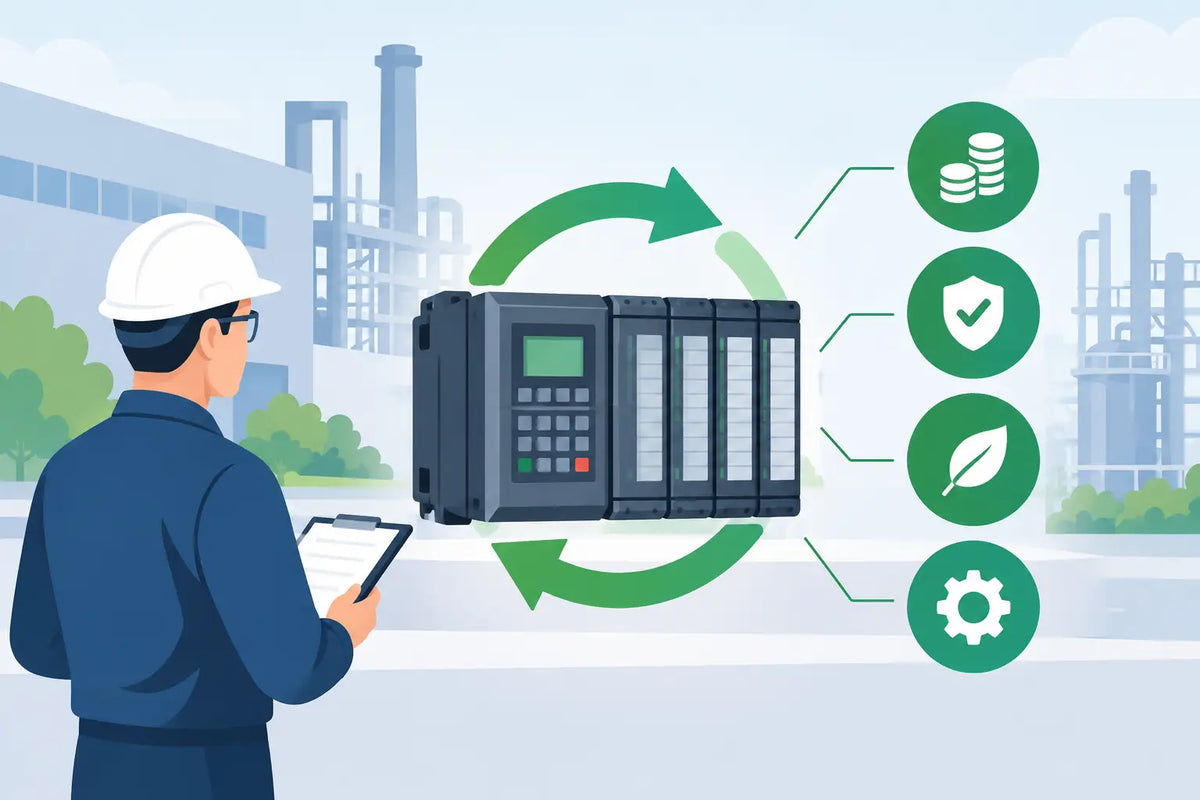
A failed PLC output card at 2 a.m. does not create a budget cycle or wait for an OEM lead time. That is where the top reasons plants buy refurbished automation parts become very practical: production needs the correct replacement, in a known condition, quickly enough to protect uptime.
For maintenance teams and MRO buyers, refurbished is not simply a cheaper alternative to new. It is often the available route to a part number that is obsolete, allocated, discontinued, or difficult to source through the authorised channel. The right decision still depends on the application, the failure risk and the supplier's condition information. But for many factory-floor repairs, refurbished controls are a sensible procurement option.
Why plants buy refurbished automation equipment
1. It protects uptime when new stock is unavailable
The most compelling reason is speed. A line can be losing output while a buyer is being quoted a long factory lead time for a current product, or being told that a legacy module is no longer supplied. Refurbished stock can fill that gap when the exact Siemens, Allen-Bradley, Mitsubishi, Schneider or Omron part number is needed now.
This matters particularly on installed systems that cannot be redesigned during an unplanned stoppage. Replacing a failed CPU, power supply, I/O module, HMI or drive interface with the matching item is usually far quicker than changing platform, modifying software and validating the whole machine again. A compatible replacement supports the immediate task: return the asset to service safely and correctly.
Availability is not guaranteed in the secondary market either. Stock changes quickly, especially for popular legacy references. That is why many plants identify critical parts before a breakdown and hold a small number of spares for their highest-risk assets.
2. It reduces replacement cost without forcing a compromise on part fit
New automation hardware is often the preferred choice for a planned installation or an actively supported system. Yet a new unit is not always proportionate for an older machine with a limited remaining service life. Refurbished equipment can reduce the cost of restoring that machine while retaining the exact form factor, terminal arrangement and system compatibility required by the installation.
The saving can be used where it has more operational value: keeping a spare on the shelf, repairing an additional unit, or funding a planned migration rather than reacting to a failure. For a site running several identical lines, the difference between new and refurbished prices may allow procurement to cover more of the critical-spares list.
Cost should not be assessed only against the purchase order value. Compare it with lost production, engineer time, expedited freight, temporary workarounds and the cost of an emergency controls upgrade. In many cases, a correctly specified refurbished module is the lower total-cost response.
3. It keeps legacy equipment serviceable
Plants rarely replace an entire control system just because one module fails. Older equipment may still be mechanically sound, familiar to operators and integrated with conveyors, safety circuits, packaging equipment or process controls that would take time to re-engineer.
Legacy support is therefore one of the top reasons plants buy refurbished components. The secondary market helps extend the serviceable life of platforms after product discontinuation. It can also provide replacement stock where a manufacturer has moved customers to a successor range that is not a direct plug-in substitute.
There is a limit to this approach. If failures are becoming frequent, documentation is poor, specialist support has disappeared or a platform creates unacceptable operational risk, migration planning should take priority. Refurbished stock is a useful bridge, not always a permanent strategy. It buys maintenance teams time to schedule change properly rather than making a rushed decision during downtime.
4. It supports a more realistic critical-spares strategy
A critical-spares programme fails when the list is too expensive to maintain. Refurbished options let teams cover more failure points without committing the full capital cost of buying every spare new.
The most useful items to consider are those with a clear failure impact and a known replacement reference: PLC CPUs, communication cards, power supplies, remote I/O modules, operator panels, servo and drive control boards, and specialist interface modules. The best candidates are normally parts that have a long replacement lead time, are installed in multiple assets or would stop production immediately if they failed.
Do not buy by product family alone. Buy by exact part number, revision where relevant, voltage, communication protocol and physical configuration. A near match can create more delay than it removes. Record the installed reference, machine location, firmware or revision requirements, and any programme or parameter backups alongside the spare.
5. It gives procurement another sourcing route
Single-source dependency is risky when a plant operates mixed OEM equipment or has ageing assets. Independent multi-brand suppliers can be useful because they source across several automation ecosystems rather than only one manufacturer's current catalogue.
That does not remove the need for normal procurement controls. Buyers should confirm the part number, stated condition, stock status, warranty terms, dispatch timing and return process before placing an urgent order. For critical applications, ask what inspection or testing has been performed and whether any repair history or condition detail is available.
Clear condition labels matter. “New and sealed”, “surplus”, “used” and “refurbished” are not interchangeable descriptions. Refurbished should be treated as its own condition category, with the supplier explaining the basis on which it is offered. A transparent supplier will also be clear about its independent status rather than implying manufacturer authorisation where none exists.
6. It makes planned repairs easier to approve
Maintenance work often competes with production priorities. A complete controls upgrade may be technically justified but hard to schedule, particularly where a plant runs continuous shifts or has limited shutdown windows. Refurbished replacements can make a planned repair small enough to approve and complete within the available maintenance period.
For example, replacing a damaged analogue input card during a weekend shutdown may avoid a wider panel modification. Replacing a like-for-like HMI can restore an operator station without retraining staff or changing the PLC programme. These are not arguments against modernisation. They are ways to keep the plant stable while a larger capital project is scoped, budgeted and tested.
7. It can turn surplus stock into working value
The secondary market works in both directions. Many sites have unused automation stock from cancelled projects, line changes, duplicate spares holdings or equipment decommissioning. That inventory may have little value sitting in a stores room, but it can be useful to another plant maintaining the same platform.
Review surplus by part number and condition before it becomes untraceable. Keep original packaging, labels and available documentation with the item. Selling excess stock can recover budget and helps return hard-to-find components to the supply chain. It also encourages better discipline around what should be held as a strategic spare and what is genuinely surplus.
When refurbished is not the right answer
Refurbished is not automatically the best choice for every application. New equipment may be more appropriate for safety-related functions, new builds, warranty-sensitive projects, systems requiring the latest firmware or cybersecurity features, and assets where the cost of another failure is exceptionally high.
The decision also depends on whether a like-for-like part will work within the existing control architecture. Check revisions, firmware compatibility, programming requirements, battery status where applicable, configuration files and any machine-specific parameters. A replacement can be electrically correct but still need commissioning before it can operate reliably.
For an urgent breakdown, separate the immediate recovery from the longer-term plan. Fit the correct replacement, verify operation using site procedures, then decide whether the event changes the asset's migration priority. This avoids treating every emergency repair as evidence that the whole system must be replaced, while ensuring repeated failures are not ignored.
A good purchasing decision starts with the exact label on the failed unit and an honest view of the production risk. If a refurbished replacement matches the application, has clear condition information and can arrive in time to protect the line, it may be the most practical option. Keep the part records current before the next failure, and the buying decision becomes much faster when it matters.