
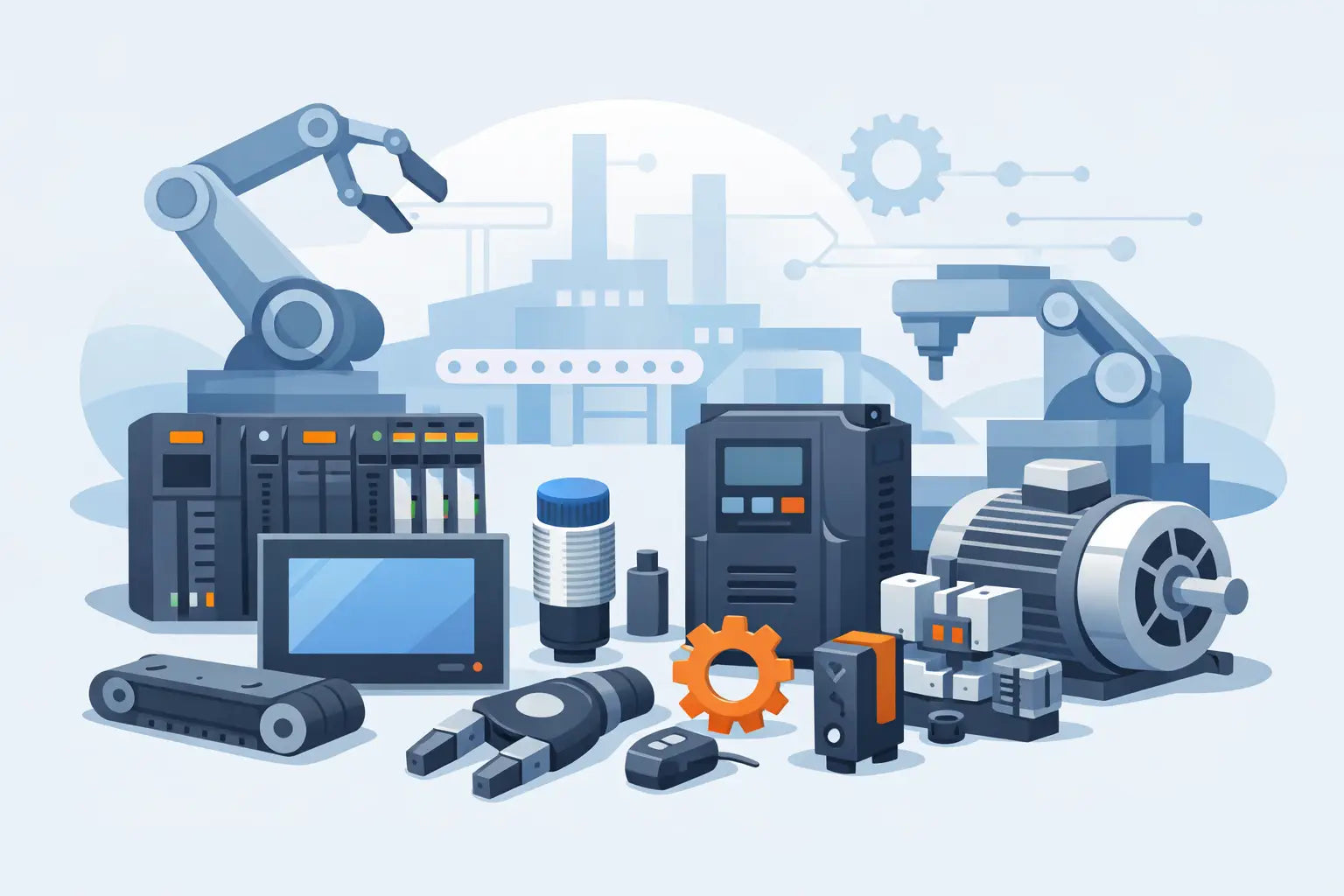
A failed input card at 2:10 a.m. does not care what your quoted lead time says. If a line is down, the question is simple - do you already have the right spare on the shelf, or are you about to pay for delay, expediting and lost output? That is why identifying the top industrial automation parts to stock is less about theory and more about protecting uptime.
For most plants, the right stock profile is not the biggest one. It is the one built around failure risk, lead time, installed base and the cost of being wrong. If you support mixed estates across Siemens, Allen-Bradley, Mitsubishi, Schneider and Omron, the job gets harder because standardisation is rarely perfect. You need enough coverage to respond quickly, without tying up budget in parts that will sit untouched for years.
How to decide the top industrial automation parts to stock
The best spare strategy starts with three questions. Which parts fail most often, which parts stop production when they fail, and which parts are hardest to replace quickly? Where those three overlap, stock is usually justified.
A small DIN-rail power supply may be cheaper than a PLC CPU, but if it fails often and takes down a panel, it deserves attention. A specialist motion module might fail rarely, but if replacement lead time is long and the machine cannot run without it, that part may also belong on the shelf. The point is not unit price alone. The point is operational exposure.
Plants that manage this well usually split stock into two groups. The first is fast-moving maintenance stock - common items with regular replacement demand. The second is insurance stock - less frequently used but critical parts for ageing or hard-to-source systems. New and sealed stock makes sense where shelf life, warranty expectations or site policy matter. Refurbished stock can be the better decision for legacy platforms, budget-sensitive spares plans and discontinued ranges where new supply is limited.
PLC hardware should be near the top of the list
If you are deciding what belongs in the top industrial automation parts to stock, PLC-related hardware will usually dominate. CPUs, power supplies, communication cards and digital I/O modules are central to machine recovery. When one fails, troubleshooting may be quick, but getting the plant running again depends on having the exact compatible part number.
The highest-priority PLC spares are rarely every module in the rack. More often, they are the components with the widest installed base across your site. If you have ten machines using the same Siemens input module, that card is a stronger stocking candidate than a specialist module fitted to one isolated skid. Standardisation matters because one spare can cover several assets.
There is also a difference between what is critical and what is recoverable. A failed CPU or backplane-adjacent power module can stop an entire process area. A failed spare analogue card on a non-essential subsystem may be manageable for a shift. That does not mean ignore analogue and speciality modules, but they usually need a more selective stocking approach.
Firmware and revision compatibility matter here. Stocking a near match is not the same as stocking the right module. Buyers who work by exact part number usually avoid expensive mistakes for that reason.
HMIs, operator panels and displays are often underestimated
HMI failures do not always stop a machine electrically, but they can stop it operationally. If operators cannot start, reset, acknowledge alarms or change recipes, the line may be effectively down. Touchscreen wear, display failure and backlight issues are common enough that key HMI part numbers should not be ignored.
This is especially true on older equipment where the original panel is obsolete or carries a long replacement lead time. In those cases, one tested refurbished unit can be more useful than waiting for a modern migration project that is still months away. Plants often delay HMI spare planning because the panel still powers on. That can be a costly assumption.
It also helps to stock the associated accessories that make replacement practical - memory cards, communication cables and mounting hardware where model-specific fit matters. A spare panel without the right setup media or connector can still leave you stuck.
Drives and soft starters deserve a risk-based approach
Variable speed drives are common failure points, but they should not all be stocked the same way. If your site uses high volumes of the same low-power drive across conveyors, pumps or fans, keeping those units on hand can make obvious sense. If you have one large, expensive drive on a non-redundant process, the decision may depend more on lead time, repair options and the cost of carrying that stock.
For drives, it is worth looking beyond the main unit. Control cards, operator keypads, braking modules and fan kits can be sensible spares if they are known wear items or common fault sources. In some environments, contamination and heat shorten service life enough that a modest drive spare holding pays for itself quickly.
Soft starters fall into a similar category. They may not attract as much attention as PLCs, but if they sit on critical motors with no bypass strategy, their failure impact is immediate. Where a standard motor control architecture is repeated across lines, one or two correctly selected spares can cover a lot of risk.
Power supplies, relays and network components move faster than expected
The parts that cause the most frustration are often the least glamorous. Panel power supplies, interface relays, Ethernet switches, safety relays and communication adapters regularly create avoidable downtime because they are treated as ordinary consumables until they fail.
These are exactly the items that can justify shelf space. They are relatively compact, generally affordable and often shared across multiple panels or machine types. If your controls architecture depends on industrial Ethernet, a failed managed switch or bus coupler can take out more than one machine zone. That pushes networking hardware higher up the stocking priority list than many sites first assume.
The same goes for communication modules. A healthy CPU is not much use if the machine cannot talk to the drive, remote I/O or supervisory layer. Plants with mixed-brand environments often rely on gateway and comms hardware to keep older assets integrated. Those parts are worth reviewing carefully, especially if they are niche or discontinued.
Safety components need a different stocking logic
Safety PLC modules, safety relays, light curtain controllers and safety contactors can be difficult spares decisions. They may not fail often, but when they do, replacement cannot be casual. Correct part number, certification, configuration and installation discipline all matter.
That does not mean you should avoid stocking them. It means stock should be tied to documented machine risk and approval processes. If one failed safety relay can halt a packaging cell for a full shift, a spare is sensible. If a specialist safety controller supports a single critical asset with long lead times, that part may warrant insurance stock even if movement is low.
The trade-off is shelf value versus downtime value. Safety parts tend to be less forgiving from a substitution standpoint, so accuracy matters more than broad generic coverage.
Sensors, encoders and smaller field devices are easy to overlook
Most spare strategies spend too much time on high-ticket hardware and not enough on the field devices that fail in day-to-day service. Photoelectric sensors, prox switches, limit switches, pressure transmitters and encoders often have shorter lives than core control hardware because they live closer to dust, washdown, vibration and impact.
If a single common sensor fault can stop a machine every few months, it belongs in stock. The same applies to encoders on motion systems where exact replacement is needed and recalibration time is costly. These are not exciting purchases, but they are often the fastest route to reducing callouts and unplanned downtime.
Consumable wear should guide stocking here. A washdown bottling line and a dry assembly area will not need the same sensor profile. Conditions on site should shape what you keep.
Stock by installed base, not just by category
A category-based list is a starting point, not a full answer. What matters is your actual installed base. A plant that is heavily Siemens-led should not spread budget evenly across every major brand just because those brands are common in the market. Stock needs to reflect what is on your floor, what your integrators support and what your maintenance team can replace confidently.
That is where part-number discipline becomes useful. Review breakdown history, OEM bills of material, obsolete assets and machine criticality together. Then rank parts by commonality, failure impact and sourcing difficulty. In many cases, a smaller list of exact, high-confidence spares will outperform a broader cupboard of hopeful substitutes.
For older systems, secondary-market availability can be the difference between a realistic spares plan and an impossible one. Where authorised channels no longer support a platform, sourcing new and sealed or refurbished parts through an independent supplier can keep assets productive for longer without forcing immediate capital replacement.
Automation Planet UK LTD supports that kind of mixed-brand procurement model, especially where buyers need exact part numbers, clear condition options and quicker access to hard-to-find stock.
The best stock is the stock you can identify fast
There is no universal spare list that suits every plant. But the pattern is consistent. Keep the parts that fail often, the parts that stop production completely and the parts you will struggle to source under pressure. For most sites, that means PLC power supplies and I/O, key HMIs, selected drives, network hardware, safety components tied to critical assets, and the field devices that maintenance replaces every month whether anyone planned for them or not.
If your stores team can identify those part numbers quickly, your engineers can fit them confidently, and your buyers know where to source new and refurbished options without delay, you are already ahead of most downtime events before they happen. The shelf is not there to look organised. It is there to buy your plant time when time is the only thing production cannot spare.