
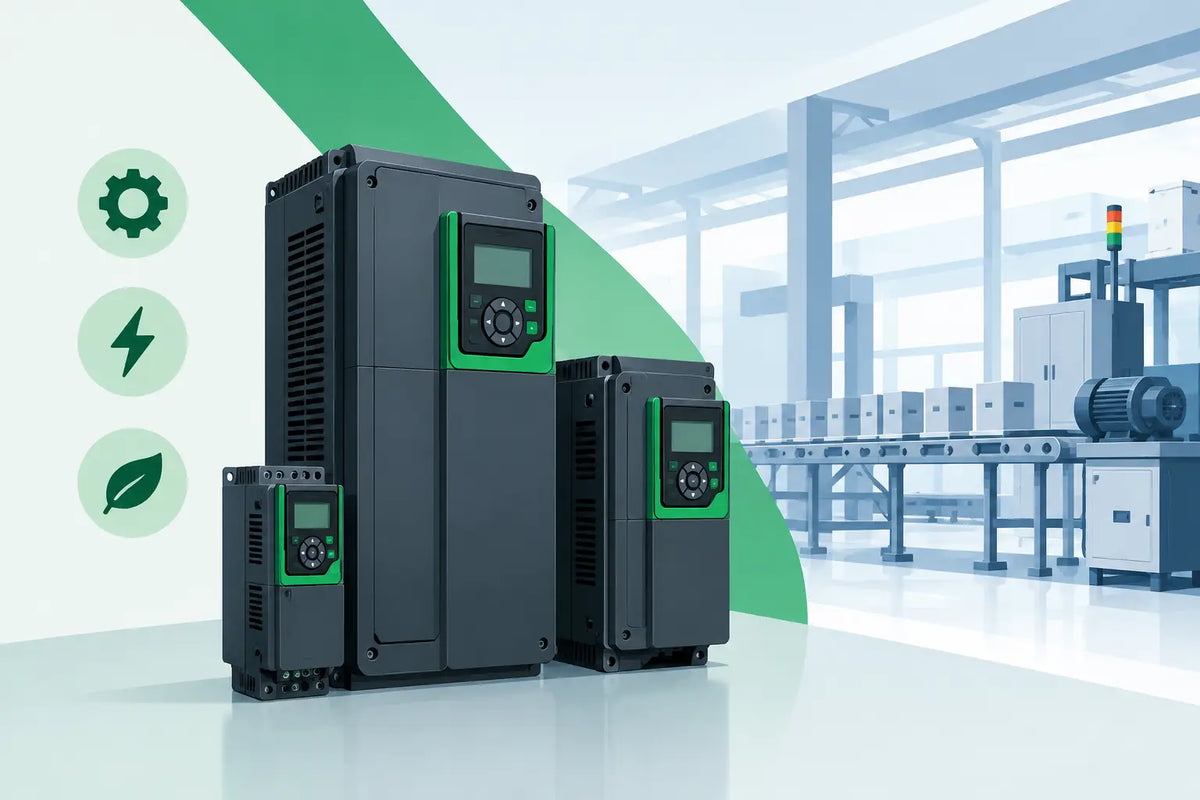
A failed drive rarely arrives at a convenient time. The useful question behind most Schneider inverter reviews is not whether the brand is generally good. It is whether a specific Altivar unit can keep a particular motor, machine and production line running without creating a commissioning problem.
For maintenance teams and buyers, Schneider Electric inverters are widely encountered in pumps, fans, conveyors, mixers, packaging machinery and general motor-control panels. The range is broad, from compact drives for simple duty to higher-specification units with advanced motor control, safety functions and network communications. That breadth is a strength, but it also makes part-number accuracy essential.
What Schneider inverter reviews should assess
An industrial inverter should be judged in the context of the application, not by a generic star rating. A drive that performs well on a lightly loaded extraction fan may be unsuitable for a high-inertia conveyor or a machine requiring controlled braking, encoder feedback or fast fieldbus response.
Schneider Altivar drives are generally valued for their established presence in industrial control, a wide choice of ratings and options, and practical integration with Schneider automation equipment. For plants already using Modicon PLCs, HMI equipment and Schneider network architectures, staying within the same ecosystem can reduce engineering time. Parameters, wiring conventions and communication support are familiar to many controls engineers.
The trade-off is range complexity. Two drives with similar kilowatt ratings can differ materially in supply voltage, overload capability, enclosure rating, input filtering, braking provision, control method and communications. A replacement selected only by motor power may fit the panel but fail to meet the duty cycle or site electrical requirements.
Where Altivar drives tend to fit well
Compact Altivar families are commonly used where straightforward speed control is the main requirement. Typical examples include small conveyors, centrifugal fans, pumps and auxiliary machinery. In these applications, the practical benefits are soft starting, adjustable speed, reduced mechanical stress and process control without the complexity of a full servo system.
For more demanding equipment, higher-specification Altivar models can provide more advanced motor control, torque performance, safety inputs and integration options. This matters where stopping distance, process stability, load changes or coordinated control affect output and operator safety. A buyer replacing a drive on a crusher feeder, hoist-adjacent process or high-torque conveyor should not assume that a basic general-purpose inverter is an equivalent substitute.
Availability is another reason Schneider equipment appears regularly on maintenance shortlists. Large installed bases mean that surplus and refurbished stock can be available when a current OEM channel replacement has a long lead time or the original part is no longer in active production. That can be valuable, provided the unit is matched correctly and its condition is stated clearly.
Strengths buyers regularly look for
The strongest case for Schneider drives is usually practical rather than promotional. The product line covers a wide spread of industrial duties, and there are many installed systems for which an identical replacement is the lowest-risk route back to production. Documentation and parameter structures are familiar to electricians and controls teams who work with the platform regularly.
Schneider also offers drive variants designed around different operating environments. Depending on the reference, buyers may find options for simple machine control, pump and fan duty, demanding torque loads, decentralised installations or higher-power cabinet applications. This allows an engineered choice rather than forcing one product family into every task.
For procurement, a recognisable manufacturer and exact part-number identification help reduce ambiguity. When a failed unit has a readable label, the preferred route is usually to source the same reference, then verify any suffixes, option cards and attached accessories before ordering.
Limitations and common objections
No inverter brand removes the need for application engineering. Some Altivar models have a learning curve when advanced functions are required, especially if the original programme uses customised parameters, communications mapping or application-specific macros. Replacing the hardware is only part of the job if no parameter backup exists.
Cost can also be a factor. A direct like-for-like replacement may be more expensive than a lower-specification alternative, while a current successor may require changes to mounting, connectors, EMC arrangements or PLC configuration. The lowest purchase price is not always the lowest downtime cost.
Legacy products present another issue. An obsolete drive may still be obtainable through the secondary market, but buyers should understand what is included. A bare inverter is not automatically a complete replacement if the original installation relies on a keypad, communication card, encoder interface, braking resistor, line choke or manufacturer-specific cable assembly.
Schneider inverter reviews: compatibility matters more than ratings
Before approving a replacement, start with the complete label reference rather than a family name such as Altivar. The rating plate should be checked against the existing installation and motor data. This is particularly important where panels have been modified over time or where the original drive was selected with extra headroom.
Supply voltage comes first. A 200-240 V class drive, a 380-480 V class drive and a 500-690 V class drive are not interchangeable, even if their motor output figures appear similar. Confirm phase arrangement, input frequency and site supply. Then check motor current, not only kilowatt or horsepower. The drive must support the motor full-load current and the actual overload profile.
Duty type changes the answer. Fans and centrifugal pumps often have variable-torque characteristics, whereas conveyors, mixers and positive-displacement pumps may demand constant torque. Starting loaded equipment, repeated acceleration, rapid deceleration and high ambient temperatures all influence the correct selection. If the old unit failed, establish why before fitting an identical replacement. Repeated overcurrent trips can point to a mechanical problem or an undersized drive rather than a bad inverter.
Control interfaces need equal attention. Check whether the machine uses analogue speed reference, discrete inputs, Modbus, CANopen, Ethernet-based communications or another protocol. A replacement with the wrong communication option can create a delay even when the power section is correct. Record terminal connections and photograph the existing wiring before removal.
New, refurbished or successor model?
New and sealed stock is usually the simplest choice when the exact reference is available and the project requires a known unused unit. It suits planned spares, safety-critical replacement programmes and installations where standardising condition is a procurement requirement.
Refurbished stock can be a sensible route for legacy repairs, especially where the original model is discontinued. The value depends on the seller being clear about condition and test process. Buyers should ask whether the unit has been functionally tested, whether any damaged components were replaced, and whether the keypad, covers and option modules shown are included. Cosmetic condition is secondary; correct operation and a documented reference are what matter.
A successor model may be the right long-term decision when an obsolete drive is becoming difficult to source. However, treat it as an engineering change, not a simple substitution. Review dimensions, heat dissipation, parameter conversion, I/O allocation, communication compatibility, motor cable length and EMC requirements. A planned upgrade during a shutdown is usually less costly than trying to redesign a panel during an outage.
A procurement check before placing the order
For urgent requirements, a short verification process avoids the familiar problem of receiving a drive that is almost right. Confirm these points against the removed unit and the machine documentation:
- Full manufacturer reference, including suffixes and revision details where visible.
- Input supply, motor current, power rating and duty or overload requirement.
- Required control voltage, I/O count and installed communication or option cards.
- Physical dimensions, mounting arrangement, cooling clearance and enclosure needs.
- Included items, particularly keypad, terminal covers, programming accessories and braking components.
Sourcing for uptime rather than catalogue comparison
Industrial buyers often need one of two things: an exact part number for a fast recovery, or a technically credible alternative when that reference cannot be found. Those are different purchasing tasks. An exact replacement reduces commissioning risk; an alternative may improve future availability but needs a fuller compatibility review.
Automation Planet UK can assist buyers sourcing Schneider and other major automation brands across new and sealed and refurbished condition options. For any urgent requirement, provide the complete drive reference, clear photographs of the label, motor details and the reason for replacement. That information is more useful than a broad request for a “Schneider inverter”.
The best purchase is the unit that matches the machine, arrives in the stated condition and can be commissioned without introducing a second fault. Start with the part number, verify the application, and keep the removed drive and its parameter record until the replacement has proved itself in service.