
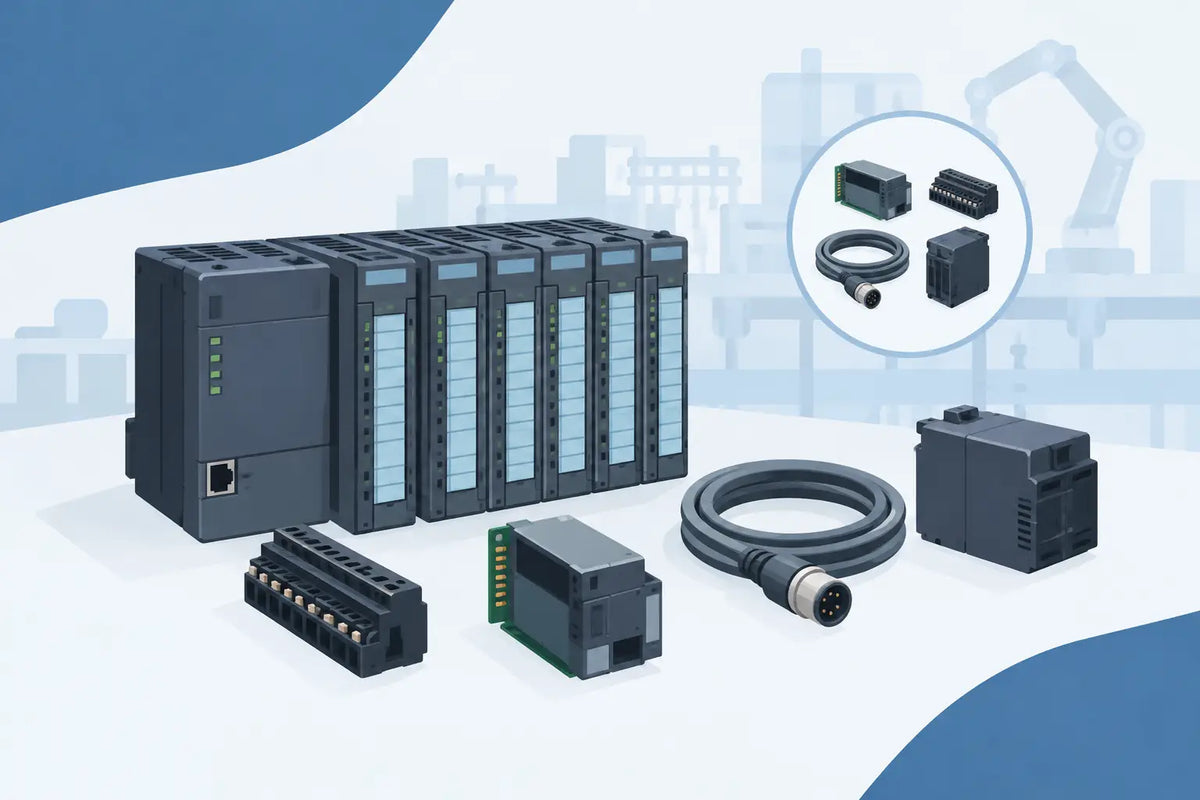
A failed input module on a 20-year-old packaging line is rarely just a £300 component problem. It can stop a shift, hold up dispatches and leave maintenance teams searching through old drawings while production waits. This legacy machine spare parts example shows the practical process of replacing an obsolete PLC module when the original manufacturer has moved the product to end-of-life status.
The objective is not to modernise the whole control system during an unplanned stoppage. It is to identify the exact failed part, confirm the replacement will work in the installed system and secure stock in a condition that suits the risk, budget and required delivery date.
Legacy machine spare parts example: a failed PLC input module
Consider a bottling machine controlled by an Allen-Bradley PLC platform installed in the early 2000s. During a fault investigation, the technician identifies a failed 16-point DC input module. The label on the module reads 1746-IB16. The rack is an SLC 500 chassis, the processor remains operational, and the machine programme has not been altered.
This is a good legacy machine spare parts example because the part number, rather than a general product description, determines the buying decision. Searching for “Allen-Bradley input card” may return hundreds of items that look similar but have different voltage ratings, point counts, terminal arrangements or platform compatibility. A 1746 module belongs to a specific family and cannot be treated as interchangeable with a CompactLogix, ControlLogix or MicroLogix item simply because it performs an input function.
The maintenance team first confirms that the module itself is faulty. They check the supply voltage, field wiring, terminal block condition, indicator behaviour and any diagnostic information available through the processor. Replacing a healthy module will not solve a broken sensor circuit, damaged cable or failed power supply.
Once the module is confirmed as the cause, the required description becomes clear: Allen-Bradley 1746-IB16, 24 V DC, 16-point input module, for an SLC 500 system. That level of detail gives procurement a usable specification and helps prevent an incorrect substitute being ordered under time pressure.
Start with the installed part number
For legacy automation equipment, the label on the fitted unit is the strongest starting point. Photograph the front label, side label and terminal block where possible. Record every suffix, revision marking and accessory reference. Some products have variations that affect communication type, memory size, input characteristics or connector style.
The core part number may be enough for a direct replacement, but do not assume all suffixes are irrelevant. A processor, motion controller, network card or drive can have firmware and revision dependencies that an ordinary digital I/O module does not. If the failed item has a removable terminal block, memory module, battery, keying piece or communication cable, establish whether those items are already present and reusable.
Machine documentation helps, but it should be treated as supporting evidence. Electrical drawings can be out of date after years of engineering changes. The physical part in the panel, the PLC programme and the installed rack layout normally provide the more reliable answer.
Check the function, not just the family
A part number match is the preferred route for urgent maintenance. When an exact match cannot be found, an approved alternative may be possible, but only after an engineer reviews the technical differences. Check the operating voltage, signal type, isolation, output current or input threshold, rack location, wiring method and programme addressing.
For example, replacing a DC input module with an AC input module is not a minor variation. Nor is changing from relay outputs to transistor outputs without reviewing the field devices and circuit protection. An apparently similar module can introduce a fault that is harder to diagnose than the original failure.
Decide between new and refurbished stock
Legacy parts are commonly available as new and sealed surplus stock or as refurbished stock. Neither condition is automatically right for every site.
New and sealed stock can be preferable where a plant has strict internal requirements, the component is safety-adjacent, or the buyer wants an unused unit for critical stores. It may also be the sensible choice for a low-cost module where the price difference is small.
Refurbished stock is often a practical option when the product has been obsolete for years, new surplus availability is limited, or a maintenance budget needs to cover several spares. A properly assessed refurbished module can restore a running machine quickly at a lower purchase cost. The key is clear condition information, traceable part-number confirmation and a seller that can answer questions before the order is placed.
The trade-off is straightforward. New and sealed stock may offer more confidence about prior use, but it can command a higher price and may be harder to locate. Refurbished stock can improve availability and reduce cost, but buyers should make sure it is the exact specified item and understand the seller’s stated condition and returns process.
Verify compatibility before placing the order
The bottling-line example is simple because the replacement is like for like. Even so, procurement should send the supplier enough information to prevent avoidable delay: the complete part number, quantity, required condition, photographs if labels are unclear, and the urgency of the requirement.
For more complex items, include the controller family, firmware version where relevant, communication protocol, power rating and machine application. Drives, HMIs, processors and remote I/O adapters need more scrutiny than a standard input card. A small detail such as Profibus versus Ethernet, 120 V AC versus 24 V DC, or a different encoder interface can make a stocked component unusable.
It is also worth checking whether the fault has damaged connected equipment. If an output module has failed following a short circuit, inspect the solenoid, contactor coil or valve circuit before fitting the replacement. Otherwise, the replacement part may fail as soon as the machine is powered.
Avoid unplanned platform changes
When an obsolete part is difficult to source, a full controls upgrade may be the right long-term project. It is not usually the right response to an immediate breakdown unless no replacement route exists.
Changing from an SLC 500 platform to a newer controller can require programme conversion, panel modifications, new I/O, network changes, safety validation, commissioning time and production access. Those are manageable tasks when planned. During a live stoppage, they can turn a one-day repair into a lengthy engineering project.
Use the exact legacy spare to recover production where feasible. Then assess modernisation separately, with a defined scope, planned downtime and a realistic budget.
Build a better spare-parts position after the repair
The best time to identify critical legacy spares is after a failure has exposed the gap. Once the replacement module is fitted and the machine is stable, record the part number, rack position, supplier details and date of replacement. Add the item to the site’s critical-spares list if its failure would stop production.
A useful critical-spares review covers more than PLC I/O. Include processors, power supplies, communication modules, HMI panels, servo drives, VFDs, specialist sensors and proprietary cables. Rank them by production impact, likely failure mode, lead time and availability in the secondary market.
Do not fill a storeroom with every obsolete part ever fitted. That ties up capital and can leave stock ageing on the shelf. Focus on components with long replacement times, no easy substitute and a clear effect on safety, quality or throughput. For a line that runs around the clock, holding one tested spare processor may be more valuable than holding several non-critical modules.
Surplus stock also deserves attention. Plants often hold unused automation hardware after upgrades, line changes or project cancellations. A part that has no value on one site may be the exact urgent requirement for another. Selling excess stock can recover budget and return hard-to-find equipment to the supply chain.
What this example means for urgent buying
In the example above, the correct action is not to buy the nearest-looking input card. It is to source a verified 1746-IB16 in the required condition, fit it after checking the field circuit, and retain accurate records for the next failure. The approach is the same across Siemens, Mitsubishi, Schneider Electric, Omron and other automation platforms: start with the exact identifier, confirm the installed application, and only consider substitutions with engineering approval.
Automation Planet UK can help buyers source part-number-specific new and sealed or refurbished automation components across multiple OEM ecosystems. For an urgent request, provide the complete part number, quantity, condition preference and any known compatibility details.
A legacy machine does not need to become a permanent production risk. A clear part-number record and a sensible critical-spares plan give maintenance teams a faster route back to operation when the next module fails.