
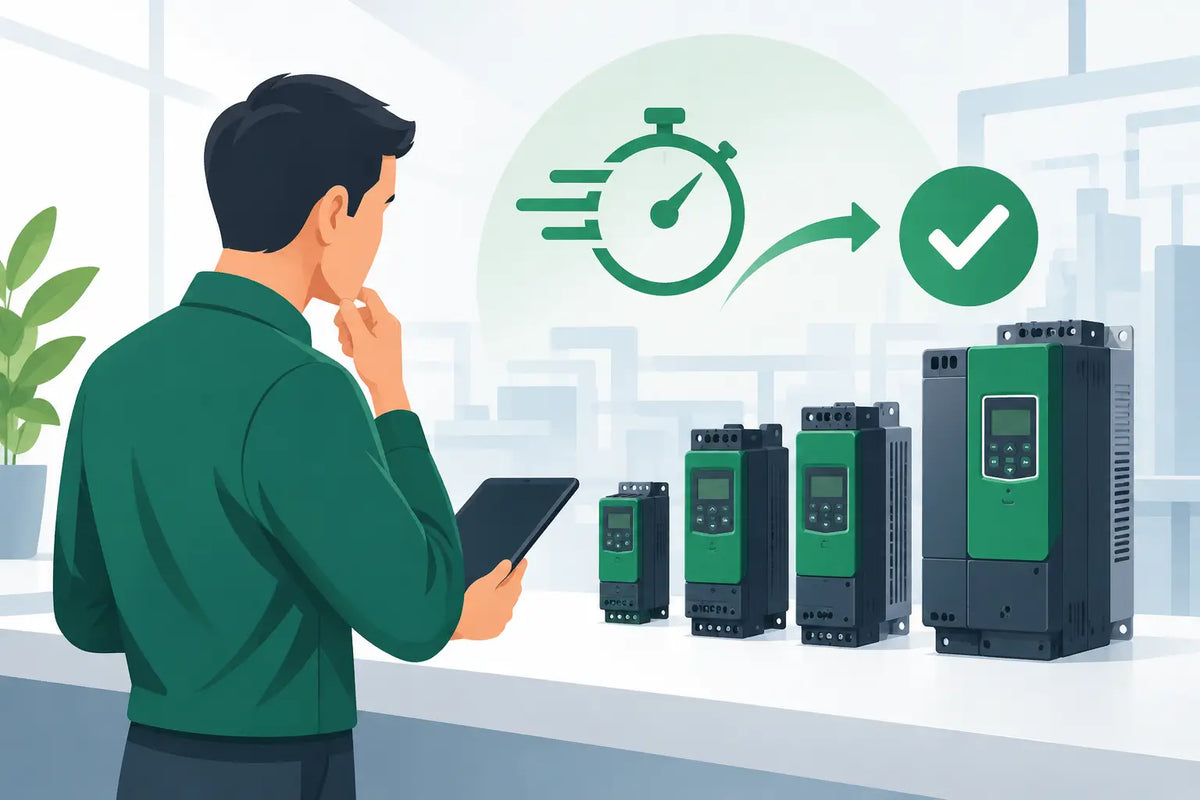
A stopped conveyor, pump, fan or packaging line rarely leaves time for broad product research. When a variable speed drive fails, the priority is to identify Schneider drive replacement units that will fit the existing application, accept the available supply, communicate with the control system and restore production without creating a second fault.
For maintenance teams and procurement buyers, that means buying by the full manufacturer part number first, then checking the details that can make an apparently similar drive unsuitable. A drive’s physical size or motor kW rating alone is not enough. Supply voltage, output current, overload duty, control method and installed options all affect whether it can replace the failed unit.
Start with the complete part number
The rating label on the failed drive is the best starting point. Record the complete Schneider Electric reference, including every suffix, rather than searching only for the drive family. A single family can cover multiple voltage classes, different enclosure formats, braking arrangements, EMC configurations and communications options.
Photograph the label before the unit is removed if possible. Also record the serial number, the application, the motor data and any fitted accessories. The original order paperwork may help, but the label and the installed configuration usually provide the more reliable evidence for an urgent replacement.
A part number match is normally the lowest-risk route because it preserves the original electrical and mechanical specification. It can also reduce the commissioning work required. That does not mean a matched unit can simply be powered up without checks. Parameters, motor settings and safety functions still need to be reviewed before returning equipment to service.
If the exact part is unavailable, identify the replacement only after comparing the failed drive’s technical requirements against the proposed alternative. A newer generation may be suitable, but it may need a different mounting arrangement, revised programming, new connectors or a compatible communication card.
What to verify before ordering a replacement drive
The fastest purchase is not always the quickest route back to production. Confirming a few details before placing the order can prevent a costly return, delayed installation or damaged motor.
First, verify the incoming supply. Schneider drives are available for different single-phase and three-phase supplies and voltage ranges. A 400 V class unit is not interchangeable with a 230 V class unit, even where the motor power figures look similar. Check the actual site supply, not just the nominal voltage used in internal descriptions.
Next, compare output current as well as motor power. The motor nameplate current and the application load determine the required output rating. High-inertia conveyors, crushers, hoists and frequent start-stop duties may need a higher overload capability than a lightly loaded fan. For pump and fan service, a standard-duty drive may be appropriate; for constant-torque machinery, it may not be.
Control and feedback requirements matter just as much. Establish whether the machine uses basic terminal control, analogue speed reference, fieldbus communications, encoder feedback or a dedicated safety circuit. A drive that runs the motor but cannot communicate with the PLC or support the required safe torque off arrangement is not a complete replacement.
Finally, inspect the physical installation. Note the frame size, fixing centres, cooling clearances, cabinet ventilation, cable entry direction and any external braking resistor. If the old drive has an option module, keypad, terminal cover or communication card, include those references in the enquiry. Those smaller items are often overlooked until the replacement is already on site.
Exact-match units versus newer alternatives
An exact replacement is usually the practical choice when downtime is critical and the existing programme is proven. It reduces engineering changes and may allow the original wiring, accessories and control architecture to remain in place. For legacy Altivar installations, this can be especially valuable where a plant has standardised spares, documented parameters and trained technicians familiar with the drive family.
There are circumstances where a newer alternative is the better decision. If a drive family is obsolete, stock is limited or the equipment has recurring failures, an upgrade can improve long-term supportability. It may also offer better diagnostics, network integration or energy-management functions.
The trade-off is commissioning effort. A newer unit may require parameter conversion, changes to I/O logic, revised cable screening practices, different safety wiring or PLC updates. It should be treated as an engineering change, not merely a stores replacement. For a production-critical asset, allow time for testing during a planned stop unless the application and compatibility have been fully assessed.
New sealed or refurbished stock?
Condition is a procurement decision as well as a budget decision. New sealed Schneider drive replacement units are often preferred for capital equipment, safety-sensitive applications, customer warranty requirements or planned standardisation programmes. They offer an unused unit with the original product specification, subject to the exact item supplied.
Refurbished stock can be a sensible option for an urgent repair, a legacy machine or a spare that must match an older installation. It may also reduce acquisition cost where a current-production equivalent would require wider modifications. The key is clarity: buyers should confirm the stated condition, the exact part number, what is included and the seller’s return terms before ordering.
Do not assume that a refurbished drive includes every accessory shown in a catalogue image. Keypads, covers, mounting hardware, option cards and manuals may be separate items. Likewise, a new sealed unit may be old stock from a discontinued range. That can be useful for exact replacement needs, but it is worth considering whether to purchase a second spare while matching inventory remains available.
Protect the parameter set before removal
A replacement drive cannot recover information that was stored only in the failed unit. Where the existing drive is still accessible, save or document its parameter set before removal. Record motor voltage, rated current, base frequency, acceleration and deceleration times, minimum and maximum speeds, ramp selection, fault-reset arrangement and control-source settings.
For networked equipment, capture the node address, communication protocol, register mapping and PLC function blocks where relevant. For machinery with braking, note the braking resistor value and duty cycle. If an encoder or safety module is present, obtain its reference and confirm the replacement drive supports it.
If the old unit has failed completely, use the electrical drawings, PLC backup, machine documentation and settings from an identical line to rebuild the configuration. Avoid copying parameters blindly from a different motor or application. A drive configured for one conveyor may behave unpredictably on another, even when the hardware reference is the same.
Commissioning checks that avoid repeat downtime
Once the replacement is installed, carry out the required electrical safety and isolation procedures before energising the panel. Check supply connections, motor terminals, earthing, control wiring and screen termination against the drive documentation and site standards. Confirm that no loose strands, damaged insulation or incorrectly landed analogue wires remain from the failure event.
Before full production, verify four areas: motor rotation and direction, current draw under load, control commands from the machine system, and fault response including emergency and safety functions. Start at a controlled speed where the process allows it. Listen for abnormal motor noise and watch for overcurrent, earth fault or DC bus alarms that may point to the original cause rather than the replacement unit.
A failed drive is sometimes the symptom, not the root cause. Restricted cooling airflow, contaminated cabinets, poor earth connections, output cable damage, motor insulation failure, incorrect braking arrangements and supply disturbances can shorten the life of the next unit. Inspect the surrounding system before closing the job.
Build a spare strategy around critical drives
For assets where an hour of downtime has a measurable production cost, holding a verified spare is often cheaper than searching after a failure. Prioritise drives that are obsolete, have long lead times, use specialist option cards or support single points of failure on a line. Keep the part number, condition requirement, firmware information, parameter backup and compatible accessories together in the maintenance record.
Automation Planet UK LTD can help source exact-reference automation stock across current and legacy product ranges, including new sealed and refurbished options. As an independent supplier, product availability should always be checked against the required part number and condition rather than assumed from a family description.
The useful spare is not simply the drive on the shelf. It is the drive whose rating, options and saved configuration have already been checked, so the next fault becomes a controlled maintenance task rather than a production emergency.